Thursday, 23 July 2009

Is swine flu really all that bad?

Now I am not denying the fact that there is a nasty novel variant of type A H1N1 influenza out there. And that it has an interesting and rather nasty set of symptoms to it. But a good comparison to be looking at is how it compares to the seasonal flu statistics from previous years.

And this is exactly what happens in part of this article in the Otago Daily Times (ODT - my local paper). Mostly the article was about how with the University semester starting last week and many students coming back into town there has been a surge in the number of cases suspected, especially at the University's student health centre. It reports that there are (have been?) 2443 confirmed cases nationwide (as of Tuesday), which was up 80 from the day before, with 26 in intensive care and 11 deaths.

The comparison comes at the end of the article, where it states that the total number of influenza-related deaths (for all subtypes) so far this season (April - end of June) was 109, and this compares to 479 deaths for the last year for which the Ministry of Health had released figures, 2006. So with seasonal flu being a winter months phenomenon then we expect that most of the cases occur between April and maybe October (the winter months for us in the southern hemisphere - ok here I have included most of autumn and the start of spring).

What this suggests, at least at first glance is that this has been a quiet year so far for seasonal flu although this years numbers do not include the coldest month of July. And further more that swine flu has not been a major factor in influenza deaths so far.

So while there may be lots of cases (especially suspected cases - if the anecdotes I hear from friends and family are to be believed), this flu certainly here in NZ does not seem to be much to worry about. Especially in comparison to previous flu pandemics such as 1918. This of course could be some what due to the reaction of bodies like WHO and the local health authorities and their publicity/education campaigns about how to prevent the spread of the disease.

Though it is interesting to note that the North American region is having a lot of cases out of flu season. I guess we will all have to wait and see what happens.

Continue Reading...

Monday, 20 July 2009

A funny thing happened on the way back from the Moon

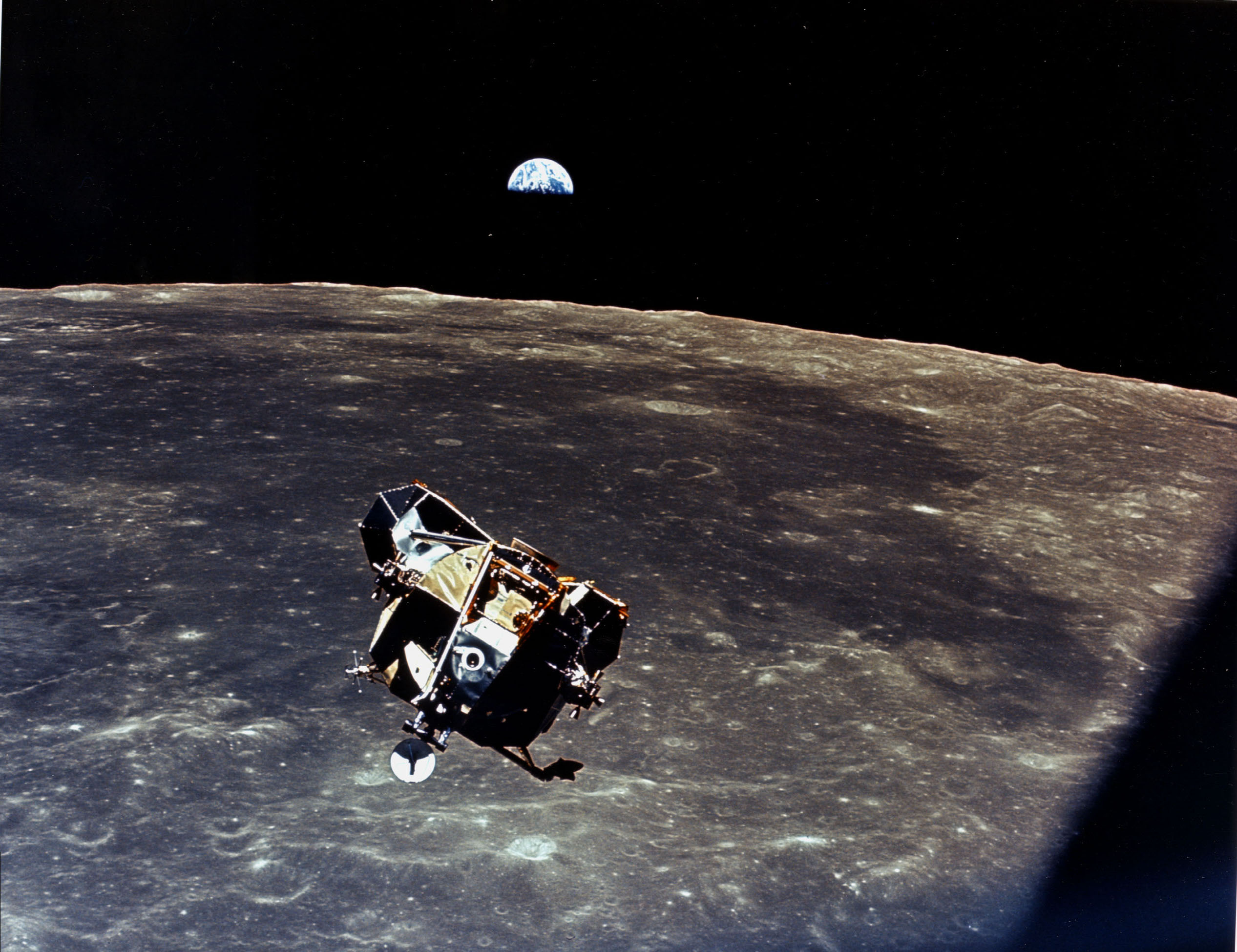
40 years ago tomorrow Micheal Collins in the Command Module Columbia snapped this pic of the ascent stage of the Lunar Module Eagle as they returned from the surface of the moon.

And in the couple of years following this 10 more men walked on the surface of our planet's orbital buddy, following in the historic footsteps of Armstrong and Aldrin (40 years ago today- so I will wish Tranquility Base happy 40th birthday).

Unfortunately to this day some people do not believe, for various reasons, that we never set foot on the moon (for example see here).

But one of the results of this walking/driving on our natural satelite is that we left an awful mess behind us. Descent stages of the lunar landers, flags, rovers, scientific equipment, footprints, the list goes on. One of the denier arguments goes along the lines of well if this stuff is there why can't we see it. The answer to which is that it is too small.

That is until now. Recent photos taken by the Lunar Reconnaissance Orbiter (LRO), which entered orbit around the moon in the last few weeks has a camera with enough resolution to quite clearly see that which we left behind. Many more details can be found here on the NASA site. These photos are awesome, I mean just look at this:
You can even make out the path the astronauts took to set up the scientific experiments that they left behind. And the good news is that these photos were not taken at the final mapping orbit of the satellite and hence are not at the fullest resolution that the onboard camera will be able to see. So keep a look out there will be more and better photos of these sites as the LRO mission continues.

Thanks to Starts With A Bang and Astronomy Picture of the Day for the links

Update: oops got my dates wrong again - for some reason the 19th always sticks in my head but the lunar landing happened on the 20th.

Continue Reading...

Friday, 3 July 2009

Cosmic Rays, Clouds and Climate

For some reason I am still not sure of I ended up this afternoon on the wordpress homepage and one of the featured blogs was last year's weblog award winner for best science blog What's Up With That (WUWT).

If you have never come across this blog before, and I have only ever heard about it in passing, they are of some what of a climate change denialist point of view (which as Phil mentions in that last link just shows that all the webbies are is a popularity contest rather than an evidence based award). The post that was front and centre on the blog was this one about the relationship between cosmic rays and cloud formation. What really caught my attention was the juxtaposition between the "headline": Message in the CLOUD for Warmists: The end is near?, and the graph that followed the first paragraph.

Now the paragraph (and actually the graph) talk about the correlation between cosmic rays (using various isotopes as a proxy) and temperature. Much of the rest of the post is a quite interesting description of the CERN experiments and hypothesis that links the galactic cosmic rays (GCR) and cloud formation, and while that is all interesting it is irrelevant to what I wanted to say, even if this turns out to be correct.

Now if you look closely at the graph you can see that it covers the last almost 800 years and the proxies for the GCR (10Be and 14C which are the blue and black lines) correlate very well with the red line (Siberian Temperature). They track each other quite well through the dark ages and into the medieval warm period and even through the maunder minimum (little ice age) right up until the middle of the 19th century. Now once we get to the late 19th century we see that the temperature continues to rise and the other lines level off a bit - you can still see that there is a slight influence with the dip in temperature around early to mid 20th century but the lines in general are no longer closely correlated.

Oops! Maybe if you are going to make an argument you should make sure that your strongest piece of evidence does not plainly and in clear sight contradict your argument.

What does that all mean, firstly well it looks remarkably like the temperature and sunspot cycle length plot I showed previously and as I stated in that post what we can see is an excellent correlation spoiled since the industrial revolution. I left a comment on the WUWT blog that outlined the above lack of modern correlation and stated that what has happened since the industrial revolution that we know may have caused this warming, well we have been putting out a lot of CO2.

Other commenters on the WUWT blog mention that CO2 is a very minor atmospheric constituent and that H2O is a better green house gas and much more prevalent. Well this is also true, however H2O has some rather interesting behaviors it saturates quite easily in the atmosphere and everyone that does not live in desert (or at least a drought) gets to experience this - RAIN! Also if you have ever been to the tropics, you may have noticed that the rain can be quite heavy when it is warm this is because increasing the temperature allows the atmosphere to hold more water.

If water vapor itself was enough to trigger the sort of greenhouse effect that we are seeing then we would have long ago passed the point of now return, but fortunately the saturation of water in the atmosphere (what we call 100% relative humidity) seems to prevent this from happening - although this is not to say that when the temperature does get warm that there will be more water in the atmosphere which will probably on lead to worse storms etc rather than any large feedback effect (which means I had to write a retraction since I claimed that there may have been an H2O feedback in my original comment on WUWT - ooops gotta think the consequences through more).

Continue Reading...

Bad experiment design

Here in New Zealand we tend to import big important current affairs shows such as 20/20 and 60 Minutes, of course we put our own host upfront and show a couple of local stories as well as the interesting ones, mostly from the US, that seem to come with the program.

Well on Monday, during 60 Minutes they had a discussion (and this was one of the local stories) about food coloring and children's behaviour (the video clip of the story at the link). They talked with the experts and afflicted parents about how food coloring is bad and is being phased out in places and why are we not doing it etc. This in and of itself is reasonable and studies have shown that coloring can lead to hyperactivity in (some) children

But the really bad part of this was when they set up an experiment to show just what effect that the colorings have. They got some parents to lend their children (the kids all looked to be around 6-10 maybe) to the demonstration and put them in two groups. One group would have a healthy color free afternoon tea and the other group would have an afternoon tea full of colorings. They tested the children by getting them to do a drawing and some writing both before and after the food, and the children with the color free food had very little change in their drawing/writing while those in the color group there was a marked decrease in competency. However the best illustration (as far as the producers and the anti-color people were concerned) was that the kids in the color group were just bouncing off the walls and in one case bouncing balls of the presenter and interviewee (a child psychologist I think).

On the face of it this sounds like a great demonstration that showed up exactly the concerns that exist about the colorings. The problem was in the controlling of the coloring/non-coloring foods. The coloring group got all the foods that you can give to kids with heaps of the bad colorings in them, things like candy, cordial drinks and coke and that sort of thing. The non-colorings group had lots of fresh fruit and water.

If you have not spotted why this does not show colorings in a bad light then maybe go back and compare those snacks again. The colorings group not only got colorings that the non-colorings group did not get but they also got lots of high sugar food (especially refined sugars) and caffeine that the control group did not get, for those of you at home these are known as confounding factors.

So what did the demonstration show, that a combination of lots of sugar, caffeine and coloring leads to kids bouncing off the walls. Last time I checked with my two little boys (and their friends) that amount of sugar alone will set kids off, as I witnessed at my elder boy's 4th birthday party last weekend.

How could they have done this better, well clearly the control group should have had the same amount and type of sugars, that way you would have been able to see the effect of the colorings, rather than what I suspect was mainly the effect of the sugar that these kids got to stuff themselves with. An example of a way that this could have been done was to use cordial drinks alone as the difference between the groups as many brands put out a color-free variety as well as the usual colored ones.

Unfortunately, my wife tells me that some of the other mothers at the playcentre my children go to, did not manage to see this fault in the demonstration and my wife was not able to convince them of why it did not show what they said it showed.

That all said, there does appear to be something to this hypothesis that food colorings can be bad for children's behavior - now if only we could get the TV people to realise how to design a demonstration to illustrate a point. Oh well I had better send them a copy of this.

Update: added link to clip from show.

Continue Reading...

Friday, 26 June 2009

The Power of Probability

I wanted to take a quick detour into probability today, for various reason which I don't really want to divulge.

But in particular I wanted to look at the cumulative probability of multiple independent events. Such as always rolling a 6, or always drawing a red card from a full deck.

It is fairly simple to see that if you want to roll a 6 there is a 1 in 6 or 0.16666... probability of this happening. The same goes for always drawing a red card where the probability is 1 in 2 or 0.5 (or 50%).

But once you start to choose multiple times then you see the the probabilities start to get smaller quite quickly. So the probability of rolling 2 6s, or drawing 2 red cards

  • P(2 6s) = 0.1666 x 0.1666 = 0.16662 = 0.0278 = 1/36 = 2.78%
  • P(2 red) = 0.5 x 0.5 = 0.52 = 0.25 = 25%
And then the probability of three
  • P(3 6s) = 0.16663 = 1/216 = 0.46%
  • P(3 red) = 0.53 = 0.125 = 12.5%
You can see that the dice roll is now quite unlikely less than half a percent and even the high probability drawing a red card from a full deck (which is the same as flipping a coin and getting a head - not sure why I didn't use this as my example) is down to 1/8.

What about if we say drawing 10 cards that are all red, from a full deck
  • P(10 red) = 0.510 = 0.0977%
Which as you can see is really unlikely. So over 99.9% of the time you will not get 10 red cards drawn in a row (or 10 heads on a coin toss).

Of course our examples here uses the same event happening over and over again, but the same math applies when considering events with different probabilities as long as they are independent (which means that one event does not influence any others). As long as the probabilities of the events happening is less than 1 (which would mean that that particular event always happened) then the chances of a series of events happening is more and more unlikely as more and more events are in the series.

One place where this knowledge can be quite useful is in a court case. If for example there are several pieces of evidence that show that the accused could have done the crime. What the defense will try to do is cast doubt on those pieces of evidence, such as by saying that this bloody handprint could have gotten there in a total innocent way. Of course the whole idea of the defense is to cast reasonable doubt as to the accused's guilt. But the more pieces of evidence that there are against the accused then the lesser the probability of them all being circumstantial and the greater the likely hood of the accused being guilty. Even if there is some doubt about each piece of evidence taken together they point to the accused as being guilty, even if the doubt is large such as 50% like we showed above.

Continue Reading...

Friday, 5 June 2009

Ayuveda in my paper

The online version of my local paper carried a story today under the guise of its Lifestyle and Health section about a reporters experiences trying out some Ayurvedic "medicine". It seems at least to my equal parts horror or pleasure (horror that they paid to have this and pleasure that it was not a local reporter) that this story has been imported from the LA Times and/or Washington Post. Skimming over it immediately prompted me to leave a lengthy comment on the site which I will post below for your reading pleasure.


The article mentions that few "western" doctors espouse these types of healing methods due to lack of (or inability to conduct) scientific studies.

However, those in learned circles, or at least with a working knowledge of anatomy, physiology, biochemistry and physics as well as a rational brain can clearly see that methods that have no basis in any scientific understanding of the body, such as the "doshas" (which cannot be shown to exist) have no point in being studied in clinical trials until there is a viable method for their mechanisms of action.

This is all very similar to the ideas (the four bodily humours) that science correctly discarded at the end of the middle ages as utter nonsense. Many feature of the Ayurveda and indeed traditional Chinese medicine are based on disproven ideas of how the body works.

And while more and more this sort of non-reality medicine creeps into the western (especial post-modern) philosophies, you find that in their native countries (in this case India - but it also applies to China) the locals are abandoning these methods for ones that actually work by methods other than relaxation and the placebo effects.

The statements about nutrition and the need to balance what you eat are not restricted to Ayurveda, and can be found just as readily in science-based medicine.

And as for food having energies - Yep it does... you might have heard of them they usually go by the name Calories.

Continue Reading...

Sunday, 3 May 2009

Carnival of the Godless

Hello and welcome to this latest edition of the Carnival of the Godless, for those new to carnivals this one is a fortnightly chance to submit your post on Godlessness (and all that entails) to a potentially wider audience, good for promoting your blog and engendering discussion.

We have had a very good turnout here for this edition and I will endeavour to bring it to you in a succinct fashion after all you are not here for me (at least not entirely) - although if you want to have a look around feel free to check out some of the post on basic physics, skepticism, atheism/religion or any of the myriad other topics I have discussed here.

Now on with the show...

To start with Paul Sunstone of Café Philos shares with us a parody:Helping Those With Mormon Interests.

Some of you may remember the smut for smut campaign were people could exchange their bible for porn, well Jennifurret of Blag Hag tells us of her campus groups better taste effort Fiction for Fiction.  She then goes on to ask Is "New Atheism" White Supremacist? and discuss sexuality in nature with Natural Sexuality

First time submitter Bryan W/a 'y' from Science. Why not? deconstructs at time magazine article about faith healing in Spirituality is about as good for your health as sugar pills.

lukeprog writing at Common Sense Atheism  presents a possible futuristic look back at the end of a religion The Last of the Christians.

At Right To Think yunshui compares cheeses and churches, In Cheeses' Name, Amen before looking at some of the hypocrisy of the conquistadors in Is that a beam in your eye, Mr Cortes?.

Brent Fisher gives one of his earlier musings on now that he is not religious what is he, in Humanism, a possible model for moral humans 

In a post at his bog Pleiotropy Bjørn Østman tells how he is both atheist and agnostic, which is something that I completely agree with as it is the truly skeptical point of view on religion.

Greta Christina serves us a helping of religion and the difference between possible and plausible with  Why You Shouldn't Jump Out of Windows , and follows by decrying the patronizing attitude that treats atheists, and especially queer atheists, as sad lost sheep in Why Do Queers Leave Religion?

Dr. Jim has a low down on some of his exchanges in the letters to the editor of his local paper Lethbridge's 'Militant' Atheist in Chief 'Heralded' again..

Postman delivers this letter direct from the almighty, himselfDear Union of Amalgamated Cherubim & Seraphim Local 151... posted at "Gone Fishin': Postcards From God".

Living With Mormonsgive some insight in to what goes in inside What do Mormons believe? A look at Fast and Testimony Meetings.

Beth Terry at Fake Plastic Fish (Living Life with Less Plastic) tells us her thoughts on  the purpose of life.

Metamagician and the Hellfire Club's Russell Blackford speaks aboutJerry Coyne on science organisations and accommodationism,  before going on to Harvard's Islamic chaplain: "great wisdom" in death penalty for apostates and then why we should be worried about Hate speech and the ICCPR.

Lying for Jesus seems to be a common occurrence these days and The Atheist Blogger Adrian Hayter gives us Telegraph Caught Lying For Jesus about the misrepresentation of the National Federation of Atheist, Humanist and Secular Student Societies (AHS).

larryniven of Rust Belt Philosophy presents Walking the walk about following Ontological arguments to their natural conclusions.

Michael of a Nadder! has some Optimism About Deborah 13 a BBC documentary about an "uber-Christian family with no contact with the outside world".

Andrew Bernardin discusses The Spirit World's Interest in Sex at The evolving mind

The Invisible Pink Unicorn's Ron Gold shares the story of How I Became An Atheist.

Gregory Lawrence of skin hunger brings up and knocks down some common stereotypes about the happiness of atheist in The thing that pisses them off.

vjack leading the Atheist Revolution brings up Bigotry and Religious Freedom.

PhillyChief tells of How rational people indulge in the irrational on his blog You Made Me Say It...

and in our final entry for this episode Mauzzie the Ponderer vents about those zealots.


Hope you all enjoyed the reading on offer and the next edition will be in a fortnight at State of Protest

Continue Reading...

Coming Soon

Ok those here for the latest carnival of the godless, which is due on Sunday 3 May, I apologise for the delay (that should only effect those in timezones much ahead of UT).  The carnival will be up in the next couple of hours - family sickness and deadlines at work have meant that I am behind schedule on this


Thanks for you patience and check back in a couple of hours.

Robert

Continue Reading...

Monday, 20 April 2009

Excitement

I am very excited as I have just received a brand spanking new copy of Phil Plait's Death From The Skies! very kindly purchased for me by my library - OK not purchased for me but at least at my request and as such I get to be the first to borrow and read it. Of course I now have to decide whether or not to interrupt my current read (Science of Discworld III - also from the library but renewed over the weekend so there is plenty of time yet) or to finish that first. And of course now some friends are loaning me one of their books to read - and that always puts you under a bit of pressure to read and return.

Oh well the anticipation builds, might have to wait and in the mean time just read more of Phil's excellent blog. Oh and I will do a little review here or provide some comments on the book at least when I am done.

Continue Reading...

Sunday, 12 April 2009

Today in history

There is an interesting conjunction of events in history today.  Three of the most important events have all happened today.


  1. It is Cosmonauts Day (none of this lame Yuri's night stuff).  1961 saw the first man in space, Yuri Gagarin, a Russian cosmonaut orbited the Earth once, propelling himself into history and ratcheting up the Cold War's space race.
  2. 1981 the Shuttle Columbia made its maiden flight, the first reusable space craft.  And this lovely little truck, and its cohorts, have  served space flight quite well in the intervening 28 years (although not with out mishaps).
  3. AND most importantly, with out a doubt the biggest event to happen today in history.  I was born, (lol what else would I have been talking about) 29 years ago today, yep that is right and yes I do feel old but perhaps not as old as I will feel next year.
Hope that everyone has a fantastic weekend, and enjoys the chocolate.

Continue Reading...