Showing posts with label astronomy. Show all posts

Thursday, 5 November 2009

Ares Boldly Goes

Ethan at Starts With a Bang has a great post up about just how spectacular NASA's first new rocket in over 30 years is. Videos of the test launch, which took place on 28 October 2009, has been circulating on Youtube:


But why spend all this money on sending humans into space, it is dangerous, and relatively pointless, and robots can do so well without us there. Well firstly there is at present a limit to what robots can do either on there own or with our help, problems such as they are generally designed with a specific purpose, where as a human in the same situation is much more versatile.

But the most important reason is that on this pale blue dot of ours there is a limited amount of resources and indeed time. At some point or another in the next 4 or so billion years that it has remaining, the Earth will no longer be able to support us and we will need to be somewhere else if our species is to survive. To that end we need to now begin the efforts of seeding the stars with populations of Humans (and for that matter cattle and grains etc. you know things that we will need to survive).

So by all means use the robots to find out where we can go and how we can get there and what we will find when we get there, but remember that the Earth is the cradle of humanity and one cannot stay in the cradle forever.

Continue Reading...

Monday, 20 July 2009

A funny thing happened on the way back from the Moon

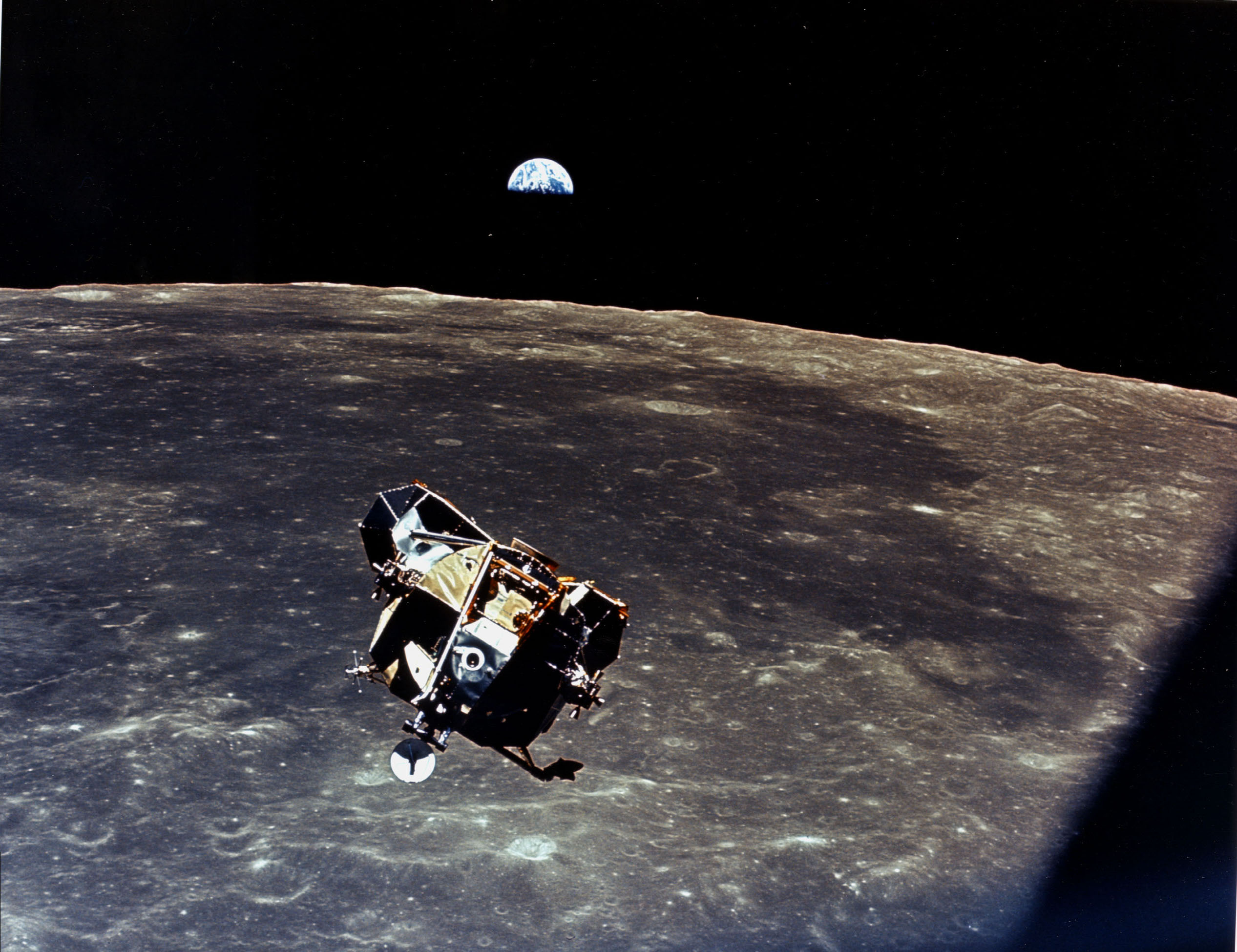
40 years ago tomorrow Micheal Collins in the Command Module Columbia snapped this pic of the ascent stage of the Lunar Module Eagle as they returned from the surface of the moon.

And in the couple of years following this 10 more men walked on the surface of our planet's orbital buddy, following in the historic footsteps of Armstrong and Aldrin (40 years ago today- so I will wish Tranquility Base happy 40th birthday).

Unfortunately to this day some people do not believe, for various reasons, that we never set foot on the moon (for example see here).

But one of the results of this walking/driving on our natural satelite is that we left an awful mess behind us. Descent stages of the lunar landers, flags, rovers, scientific equipment, footprints, the list goes on. One of the denier arguments goes along the lines of well if this stuff is there why can't we see it. The answer to which is that it is too small.

That is until now. Recent photos taken by the Lunar Reconnaissance Orbiter (LRO), which entered orbit around the moon in the last few weeks has a camera with enough resolution to quite clearly see that which we left behind. Many more details can be found here on the NASA site. These photos are awesome, I mean just look at this:
You can even make out the path the astronauts took to set up the scientific experiments that they left behind. And the good news is that these photos were not taken at the final mapping orbit of the satellite and hence are not at the fullest resolution that the onboard camera will be able to see. So keep a look out there will be more and better photos of these sites as the LRO mission continues.

Thanks to Starts With A Bang and Astronomy Picture of the Day for the links

Update: oops got my dates wrong again - for some reason the 19th always sticks in my head but the lunar landing happened on the 20th.

Continue Reading...

Monday, 20 April 2009

Excitement

I am very excited as I have just received a brand spanking new copy of Phil Plait's Death From The Skies! very kindly purchased for me by my library - OK not purchased for me but at least at my request and as such I get to be the first to borrow and read it. Of course I now have to decide whether or not to interrupt my current read (Science of Discworld III - also from the library but renewed over the weekend so there is plenty of time yet) or to finish that first. And of course now some friends are loaning me one of their books to read - and that always puts you under a bit of pressure to read and return.

Oh well the anticipation builds, might have to wait and in the mean time just read more of Phil's excellent blog. Oh and I will do a little review here or provide some comments on the book at least when I am done.

Continue Reading...

Friday, 16 January 2009

Welcome to the year

Well everyone welcome (belatedly) to 2009. I have been busy over the last couple of weeks, helping with our Summer School Astronomy course, it is quite fun to teach and we get a real mix of students (it is maths-lite and we have tried to market it arts students and the such). It does keep me very busy and while I am trying to be more active on the blog at the moment it may have to wait until after next weeks optics lab (the only real experimental science lab that we get them to do).

Still I will direct you to the first skeptics circle of the year for some good reading and if that is not enough you can check out the Carnival of the Godless from late last year that featured my Good for Goodness Sake post.

Continue Reading...

Friday, 15 June 2007

More bad news for Pluto

The Bad Astronomer has a post up about new measurements on the size of Eris. Remember Eris it is the one that started out as Xena and caused the demotion of Pluto. Any way it turns out that Eris is a bit bigger than Pluto so there is no way we can ever have 9 planets again.

Call it a planet if you want. It doesn’t matter that much to me — and less to Pluto itself — but you’ll be doing the object, and yourself, a disservice. And Eris is bigger anyway. Nyah nyah.

Continue Reading...

Tuesday, 20 March 2007

Friday's Physicsal Law - Gravity

Ok well yet again this is a catchup post of this series, it was due on Feb 30 March 2.

We all have a good daily experience with gravity, we can feel it pulling us down whatever we do. And our everyday experience on how it effects us is usually limited to the acceleration that we undergo or our weight

  • F = mg
where g is the acceleration due to gravity and is approximately 9.8m s-1. Now this is all well and good for describing the effects of gravity here at the surface of the Earth. But what it does not do is tell us anything about what gravity is or how we work out 'g' for other locations (ie surface of the Moon or Mars).

For our everyday experience, that is so well described by the above equation, we can derive myriad equations to describe the parabolic motion of projectiles, to determine time of flight, maximum height, distance traveled and velocity along the path but these equations are simply those that can be used for any acceleration (interestingly enough this equivalence between acceleration and gravity plays a role in the development of General Relativity too):

  • d = vit + ½at2
  • vf2 = vi2 + 2ad
etc.

However to get the true experience of gravity we must leave this time and place and travel back to the time when Tycho Brahe was observing the motion of the planets. And since we are travelling back in time we might as well get our selves situated nicely above the plane of the solar system so we can see everything.

Johannes Kepler using Brahe's observations deduces three laws that govern the astronomical.
  1. The orbit of every planet is an ellipse with the sun at one of the foci
  2. A line joining a planet and the sun sweeps out equal areas during equal intervals of time
  3. The squares of the orbital periods of planets are directly proportional to the cubes of the semi-major axis of the orbits
And it was upon these, in particular the Kepler's third law that Newton formulated his Law of Universal Gravity, basically by combining Kepler's law with his Laws of Motion.

Now to do this without resorting to inventing (or just using) calculus you and I will make a handwavey assumption (and one that isn't all that bad). The ellipse detailed in Kepler's first law are rather circular so to make the maths easier we will just use circles (note that a circle is a special case of an ellipse where the two foci are in the same place).

Now remember from last time that circular motion requires:
  • a = v2/r
since the velocity around a circle depends on the circumference (2πr) and the period (T) (which probably should have been mentioned in the other post):
  • v = 2πr/T
which gives us
  • a ∝ r/T2
and combining this with Kepler's third law, which for a circle can be written:
  • T2 ∝ r3
then we get
  • a ∝ 1/r2
So the acceleration and hence the force are inversely proportional to the square of the radius of the orbit (as the radius increases the force decreases). So this tells us how our weight (remember this is given by mg) varies as we change our position relative to the Earth, but what about on other planets?

Well if we were to go to the moon and weigh ourselves we would discover the scales read about 16% of what they did before we left Earth, since the Moon is smaller than the Earth then if nothing else was involved in gravity then our weight would go up, so something else must be involved and this turns out to be the mass of the object we are on (be it a planet or moon or whatever).

So this gives us Newton's Law of Universal Gravitation:
  • F = G Mm/r2
where G is the gravitational constant and has a value of about 6.67×10⁻¹¹ N m² kg-2 and M and m are the masses of the two objects (sometimes written m1 and m2).

Now many find it counter-intuitive that because of the M and m in the equation the force of gravity on me due to the Earth is the same as the force of gravity on the Earth due to me. Since clearly the Earth moves me and not the other way around. Of course we must remember that force is not the whole story, it is the acceleration that causes the motion and since the Earth ways more than me the movement of me is much more than that of the Earth.

This can be seen better in the case of binary stars, or Pluto and Charon, or any other objects that are orbiting a spot in between them. This consequence is really just an illustration of Newton's third law, equal and opposite action and reaction.

Continue Reading...

Friday, 19 January 2007

Naught of Comet McNaught

Why is it that when the best opportunity of my life time to view a spectacular comet occurs it is cloudy?

It has been cloudy here all week and I am getting frustrated. Today has been horribly grey but even on the sunny days we have had this week there has been plenty of high cloud, well at least enough to prevent a decent attempt at viewing.

Oh well at least I saw last year's (OMG that makes it seem so long ago) transit of Mercury - and helped many others see it too.

Continue Reading...